


Sasol is pursuing transformational changes to its business in a measured and customer-aligned manner, while remaining cognisant of the principles of common but differentiated responsibilities and respective capabilities, particularly in the context of developing countries. The approach is focused on sustaining a strong foundational business to preserve optionality for sustainable growth, progressively transforming the business to reduce emissions, in lockstep with the market and customers in the transition. In doing so, Sasol supports the objectives of the Paris Agreement through efforts to advance a lower-carbon future and the evolution of Sasol’s business strategy.

-
Who We Are
Overview
Sasol is a global chemicals and energy company. We harness our knowledge and expertise to integrate sophisticated technologies and processes into world-scale operating facilities. We safely and sustainably source, produce and market a range of high-quality products, creating value for stakeholders.
-
Our Businesses
Overview
Through proprietary technologies and processes the main products Sasol produces are fuel components, chemical components and co-products. From these main products and further value-adding processes we deliver diesel, petrol (gasoline), naphtha, kerosene (jet fuel), liquid petroleum gas (LPG), olefins, alcohols, polymers, solvents, surfactants, co-monomers, ammonia, methanol, crude tar acids, sulphur, illuminating paraffin, bitumen and fuel oil. Even further processing produces numerous additional products.
-
ESG
Overview
Advancing chemical and energy solutions that contribute to a thriving planet, society and enterprise.
-
Investor Centre
Overview
Sasol's investors consist of both equity investors (those invested in the Sasol ordinary shares or the ADRs) and lenders/debt investors (banks and institutional investors lending to Sasol or investing in its issues of debt instruments such as local bonds, offshore bonds, commercial paper issues, project finance, loans and other credit facilities and convertible instruments).
-
Suppliers
Overview
Supply Chain is the custodian of all external spend for the Sasol Group. It is responsible for managing supply and demand so as to ensure cost-efficiency and maximise return on spend, while at the same time ensuring effective logistics of a range of deliverables.
-
Careers
Overview
Explore existing opportunities to energise your career to the next level. Whether you are seeking a Learnership or you are Student or Graduate or Experienced Hire. Find out how you can add value to the Sasol Team.
-
Media Centre
Overview
Access media releases and view latest social media updates
Climate change

Climate change
Our approach to climate change
Sasol’s climate action approach considers evolving global and local expectations and is anchored in clear strategic focus areas. The emission reduction roadmap (ERR) guides Sasol’s transition to lower-carbon operations while advancing value creation. The company’s resilience is underpinned by a stable foundation business and a deleveraged balance sheet, enabling Sasol to reasonably navigate external factors, including policy, technology, market dynamics and physical climate risks.
Sasol addresses climate change across two key dimensions: mitigation and adaptation:
- Mitigation is primarily driven through the ERR, focusing on reducing greenhouse gas (GHG) emissions through energy efficiency and the integration of renewable energy, Secunda boiler optimisation, alongside targeted lower-carbon initiatives. Within this framework, Sasol International Chemicals contributes through its own ERR, aligned to the Group 2030 target.
- Adaptation is delivered through climate risk assessments, water security planning, infrastructure resilience and business continuity initiatives that strengthen the resilience of Sasol’s operations and value chains to the physical impacts of climate change. Together, these dimensions provide a complementary approach to managing climate-related risks and opportunities, supporting balanced delivery across Sasol’s ESG priorities.
Our sustainable advantage
Sasol is advancing a pragmatic transition to a lower carbon future, balancing environmental progress with affordability, profitability and energy security, while sustaining operations and supporting broader national socio economic priorities. This approach emphasises strategic flexibility, enabling the business to adapt to evolving markets, regulatory and technology shifts, while simultaneously creating new low carbon value streams to underpin future growth. Sasol’s pathway is designed to be environmentally, economically and socially sustainable, and aligns with the objectives of the Paris Agreement, supporting a just and orderly transition.
Our climate action
Sasol recognises the importance of climate action and acknowledges the need to reduce GHG emissions in support of the Paris Agreement and its temperature goals. Our approach is to pursue emissions reductions in a pragmatic and value-accretive manner that maintains operational performance, strengthens competitiveness, creates long-term stakeholder value and supports South Africa’s energy security. We accept the mainstream climate science assessed by the Intergovernmental Panel on Climate Change (IPCC) and align with the ambition of reaching net zero CO2 emissions by 2050, with an interim 2030 target. Climate considerations are integrated into Sasol’s broader business strategy, informing decision-making and supporting long-term value creation. Our net zero ambition together with our 2030 target are underpinned by Sasol’s aim to progressively shift our portfolio towards lower-carbon-intensity revenue streams. Sasol’s optimised emission reduction roadmap (ERR) maintains our climate ambition, while ensuring economic and operational feasibility in a hard-to-abate industrial context. Our dedicated efforts are therefore focused on generating the financial and operational headroom needed to invest and scale up renewable energy, and on leveraging our competitively advantaged Fischer-Tropsch (FT) technology to develop and produce lower-carbon fuels and sustainable chemicals from sustainable sources of carbon, in line with customer and market demand.
Climate policy advocacy
Sasol supports effective, technology-neutral carbon pricing mechanisms that drive emission reduction innovation and low-carbon investment. We advocate for policy designs, including carbon tax recycling that strengthen the price signal while taking into account the challenges faced by hard-to-abate sectors, and enable reinvestment into verifiable low-carbon initiatives. The transition is capital-intensive and long-dated and therefore depends on stable, enabling public policy that incentivises investment rather than penalising the current production that must fund these transition initiatives. In South Africa and globally, Sasol advocates for policy frameworks – such as carbon tax recycling that balance climate ambition with energy security, affordability and industrial resilience, thereby enabling industry to fund and deliver the transition at the pace required by both markets and society.
Here we provide you with the resources and updates needed to understand the implications of climate change policy shifts and how they shape our collective future.
OUR TRANSITION TO NET-ZERO
Carbon Capture and Sequestration (CCS) is emerging as a cornerstone technology for addressing hard-to-abate emissions from industries such as cement, steel, and coal conversion – sectors that are foundational to South Africa’s industrial economy. Sasol Research and Technology has taken a decisive step at laboratory scale by designing, constructing, installing, and commissioning a high pressure CO₂ mineralisation test reactor at its Sasolburg facilities. This state-of-the-art system is being used to experimentally quantify the mineralisation behaviour and long-term storage potential of geological samples provided by CGS.
CARE-O-SENE is a €40 million collaborative research programme, funded by the German Federal Ministry of Research, Technology and Space, now in its third year. Sasol teams continue to work closely with partners in Germany and South Africa to deepen understanding of next generation catalyst systems, with a strong focus on improving process efficiency and reducing overall costs. In parallel, the technical and economic viability of integrated e-fuel pathways has been strengthened through comprehensive techno-economic and life cycle assessments, supporting informed decision making for sustainable fuels deployment.
The most material contributor to Scope 3 emissions remains Category 11, use of sold products, associated with the Southern African Energy and Chemicals business. Reducing Scope 3 emissions, particularly from the use of sold products, remains complex and is influenced by external factors such as end-use sector efficiency, customer behaviour, and the pace of policy and enabling infrastructure development. For Sasol, addressing these emissions requires a systems-level approach that extends beyond direct operations and encompasses the broader energy and chemicals value chains.
This includes working with customers to support lower-carbon product use, collaborating with partners to advance enabling technologies and alternative feedstocks, and engaging with policymakers to inform frameworks that support scalable, market-based solutions. Through this integrated approach, Sasol aims to contribute to emissions reduction across the value chain while aligning with evolving market and regulatory developments.
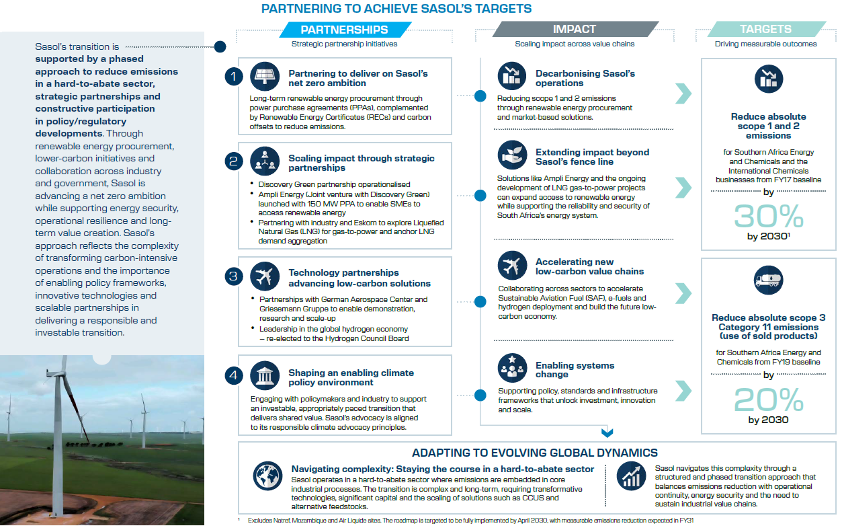
Sasol uses carbon credits and renewable energy certificates (RECs) to support its Emission Reduction Roadmap and 2030 greenhouse gas reduction targets, complementing operational emissions reductions.
Sasol supports transparent, consistent disclosure aligned with recognised frameworks such as IFRS S2, GRI and SDGs. We are dedicated to providing decision-useful information through our annual reporting suite and other public disclosures.
Climate considerations are integral to Sasol’s strategy, reflecting their importance to long term resilience, value creation and the company’s role in the evolving energy and chemical sectors.
Sasol recognises climate change as a material risk to the resilience of operations, supply chains and the communities in which it operates. Sasol’s adaptation response focuses on strengthening its ability to anticipate, prepare for and respond to the physical impacts of climate change, while safeguarding value across its integrated value chains.
As we progress towards our 2050 net zero ambition, our targets are to:
- Reduce absolute scope 1 and 2 emissions for Southern Africa Energy and Chemicals and the International Chemicals businesses from FY17 baseline by 30%
- Reduce Scope 3 Category 11 emissions associated with the use of sold energy products from this business by 20% by 2030, relative to FY19 baselines.